A student patent in renewable energy
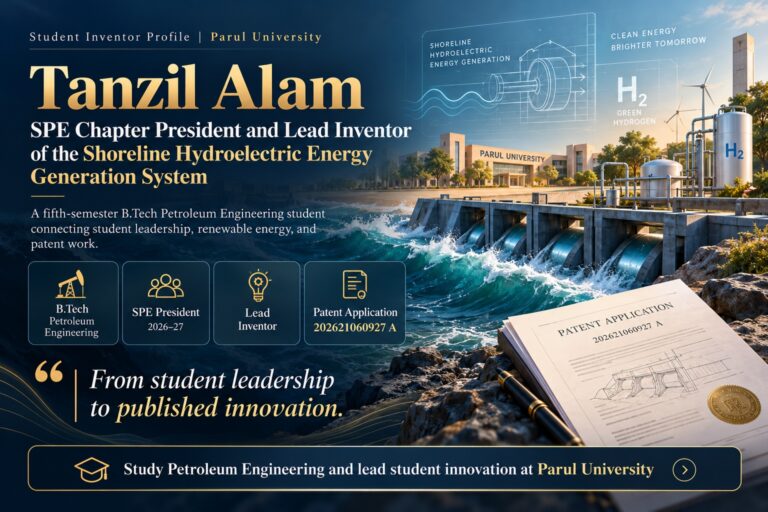
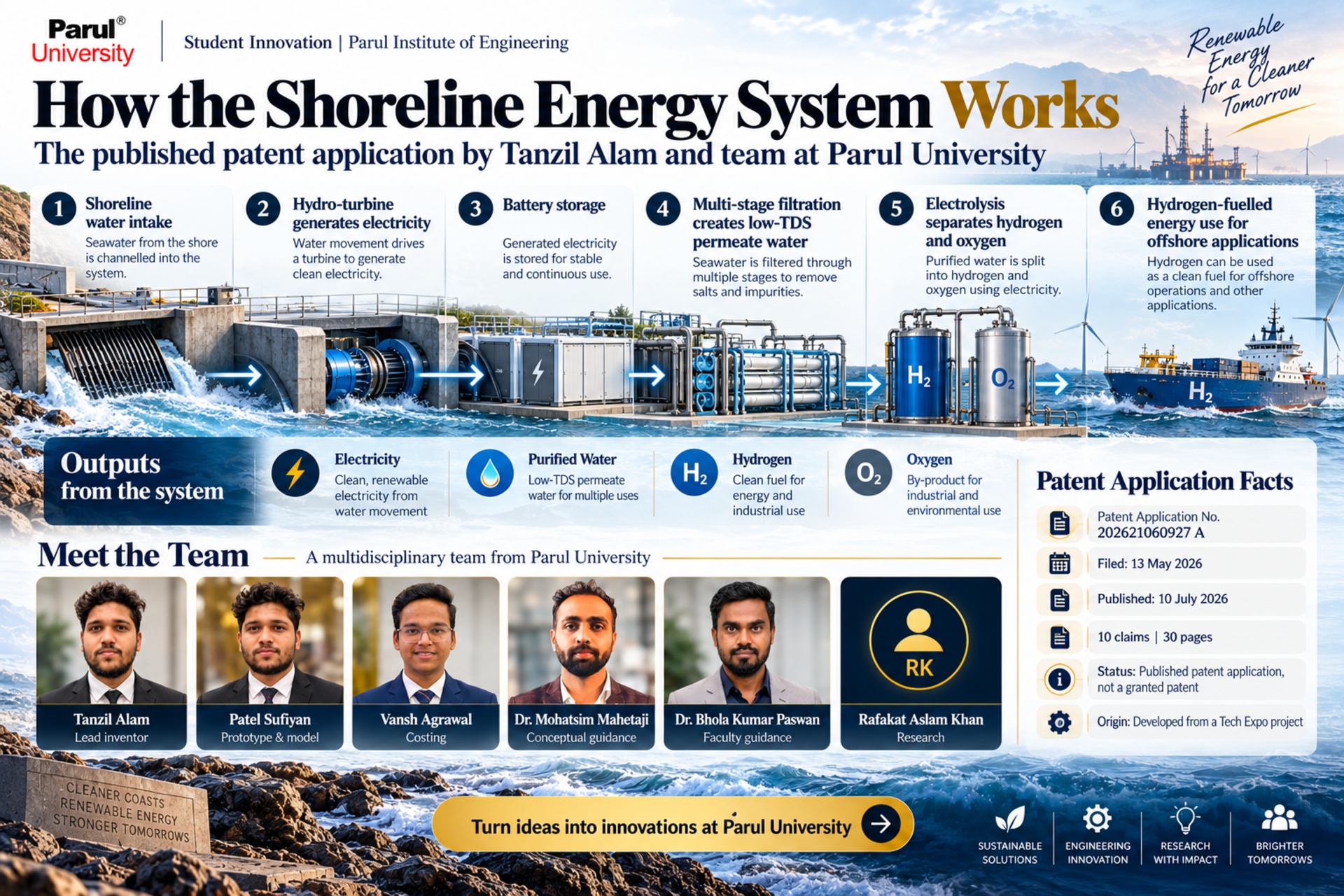
For Tanzil Alam, a fifth-semester B.Tech student in Petroleum Engineering at Parul University, an interest in renewable energy has led well beyond the conventional boundaries of his discipline. He is the lead inventor named on a published patent application for a Shoreline Hydroelectric Energy Generation System, a design that combines shoreline water-energy generation, water treatment, electrolysis and hydrogen-based energy generation into a single integrated system. According to the Patent Office Journal, Patent Application No. 202621060927 A was filed on 13 May 2026 and published on 10 July 2026. The application runs to 10 claims across 30 pages, and names six inventors: the students Tanzil Alam, Patel Sufiyan, Rafakat Aslam Khan and Vansh Agrawal, together with faculty mentors Dr. Mohatsim Mahetaji and Dr. Bhola Kumar Paswan. The work is at the published-application stage, an early and significant step in the patent process.
How the system works, as described in the patent
The core objective is to generate electricity from shoreline waves and water movement, and then use that energy for a chain of processes. As described in the published patent application, the system draws seawater through a primary intake duct positioned below the tideline, with a motorised shutter arrangement regulating the flow. A hydro-turbine assembly converts the kinetic energy of the moving water into electricity, which is stored in a battery. The water then passes through a multi-stage filtration process to produce low-TDS permeate water, which is supplied to an electrolysis module that separates it into hydrogen and oxygen gases, with dedicated storage for each. The application also describes a hydrogen-fuelled generator that draws on the stored hydrogen through a dual-channel intake of ambient air and stored oxygen. The result is an integrated chain: shoreline water movement, electricity generation, water treatment, electrolysis, hydrogen and oxygen production, and finally energy use.
The team frames the hydrogen produced this way as a potential alternative to diesel, aimed at reducing dependence on diesel-based power and the carbon emissions that come with it. The system is designed to yield several useful outputs:
- Electricity to operate the system and other offshore requirements
- Purified water from the treatment process
- Hydrogen as a potential fuel source
- Oxygen for possible medical applications
- Treated water for offshore operations
From an offshore idea to the published patent
The project did not begin in its current form, and the team is candid about how it evolved. It started under a title related to offshore hydrogen energy generation, built around producing green hydrogen offshore, and the team later refined both the concept and the title to the Shoreline Hydroelectric Energy Generation System that appears in the published application, partly to address issues encountered during the patent process. The idea took shape when a faculty member encouraged the students to enter the university’s Tech Expo. Dr. Mohatsim Mahetaji was central at the conceptual stage, suggesting the renewable-energy direction and helping the team find a focus with practical relevance, while Dr. Bhola Kumar Paswan, a faculty member of eight years, also guided the group.
At the Tech Expo, the team presented a working model to demonstrate the concept, an offshore platform with a running turbine and a visible process producing hydrogen and oxygen, which drew crowds at its stall and earned a runner-up position. A visitor from ONGC examined the project closely and discussed the patent route with the team. On the mentors’ encouragement, the students, who by their own account knew little about patents beforehand, prepared the required paper and documentation, and Tanzil Alam carried out the patent work with support from the university. The team describes the design as a first-of-its-kind attempt in India to power an offshore rig directly with the hydrogen it produces; comparable work elsewhere, the team notes, has focused on producing offshore hydrogen for sale rather than running the rig on it. These are the team’s characterisations of their work.
A team, and a lesson in collaboration
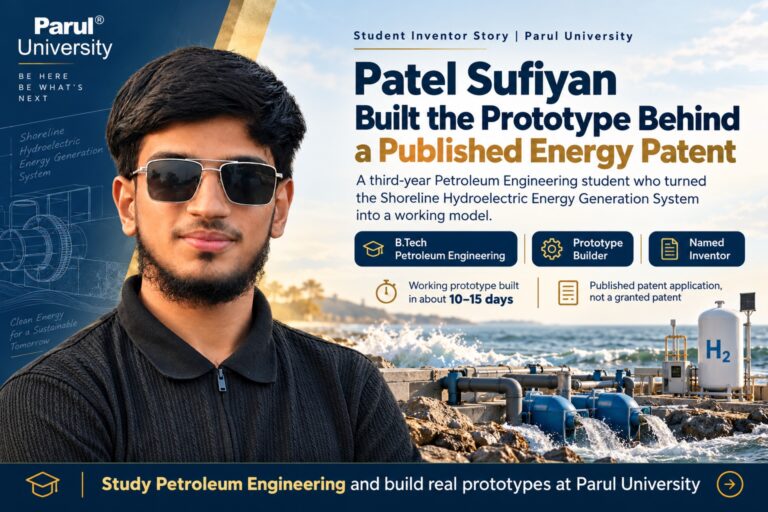
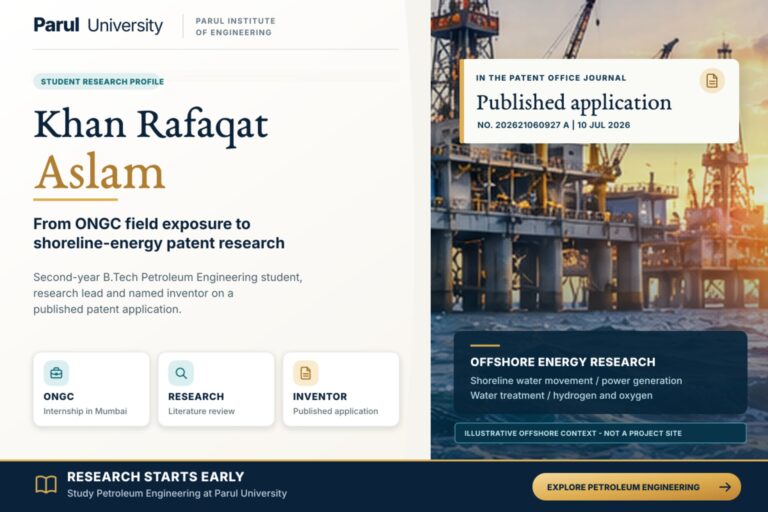
The project was built on a clear division of work among four students. Tanzil Alam led the team and developed the project with the mentor; Rafakat Aslam Khan handled the research; Patel Sufiyan built the physical model, including the pipes and related parts; and Vansh Agrawal worked on cost. Each of the students brings his own interests to the group. Tanzil, who is from Kolkata, serves as President of the Society of Petroleum Engineers (SPE) student chapter for the 2026 to 2027 tenure, where he has organised large student activities including SPARDA Fiesta 2026, which drew about 1,100 participants, with another industry-focused event planned for later in the year. Rafakat, in his second year, has completed an internship at ONGC in Mumbai and taken an early interest in research. Sufiyan, a third-year student who built the prototype, is separately working on shifting a petroleum-engineering lab experiment to an AI-based system. For a patent application in the early years of an engineering degree, the students are clear that the achievement belonged to the whole team and its mentors rather than any one member. Each of the three interviewed inventors is profiled individually: Tanzil Alam, Khan Rafaqat Aslam and Patel Sufiyan. They are B.Tech students with specialization in Petroleum Engineering.
What the project shows about learning at Parul University
Learning at Parul University is filled with lessons, observations and knowledge gained that will stay with. Even when it comes to research, publishing a patent, there is constant guidance from the professors and mentors who have worked in the field. There is a journey that follows from a classroom idea to a published patent application. It shows how students work on to bring their innovations to the surface. This innovation is created through collaboration between students and faculty. This reflects who the Parul Institute of Engineering connects coursework with research and real-world problems that require a solution. Here to make a concept students need to treat the energy generation, water treatment, electrolysis, hydrogen production, and offshore applications. This is done as part of one system. It is introduced to them so that they preserve it as the document of an innovation. This is them toward intellectual-property protection. It is part of Parul University’s wider research and innovation ecosystem. It will act as a support for students who wish to work on the ideas and turn them into projects. Or wish to have patents and ventures, and it is the kind of outcome that a research-led engineering education can provide.