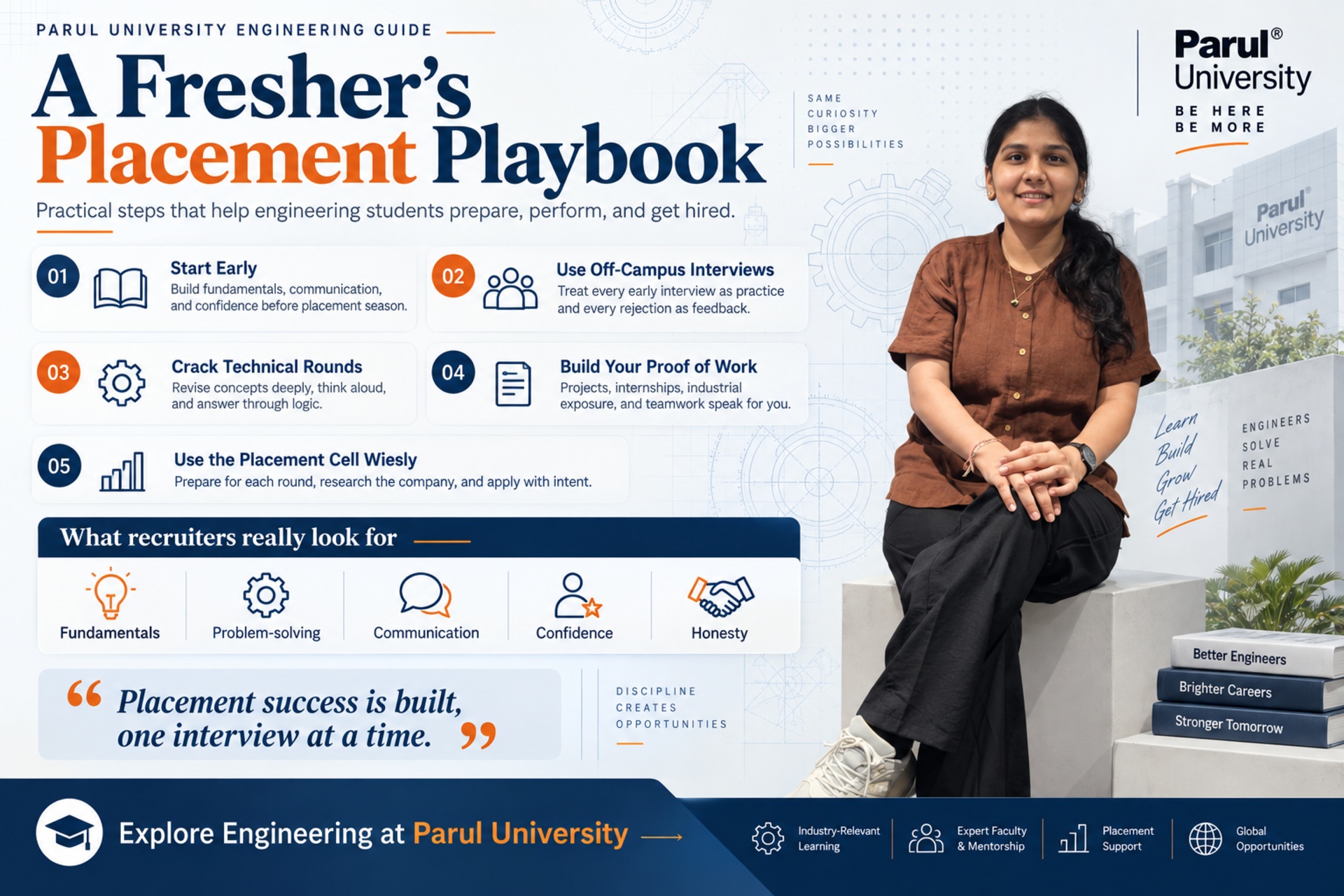
Every engineering student wants a good placement, but for a fresher with strong theory and little real-world exposure, the process can feel intimidating. The good news, as one Parul University mechanical engineering graduate’s path to Sulzer shows, is that placement success is built, not stumbled upon. Here is how to build it.
The single most repeated piece of placement advice is also the simplest: start early. Do not wait for placement season to begin preparing. Build your technical knowledge gradually across your degree, improve your communication steadily, and practise interviews well before they count. Consistency over years beats a last-minute scramble, and it means you walk into placement season already prepared rather than panicking.
Use Off-Campus Interviews as Practice
One of the smartest strategies is to treat early interviews, including off-campus ones, as practice rather than make-or-break moments. Sitting interviews before your dream company arrives teaches you what recruiters actually look for, how the process flows, and where your weak spots are. Crucially, reframe rejection: an interview that brings no offer is not a failure but a free lesson. After each one, evaluate your own performance, identify what to improve, and prepare better for the next. Confidence, it turns out, is mostly accumulated exposure.
Cracking the Technical Interview
For most engineering freshers, the technical round is the hardest part, and understanding why helps you prepare. Recruiters are not only testing what you know; they are testing how you think, solve problems, and communicate your reasoning. Practical, scenario-based questions reward analytical thinking over memorised definitions. To prepare well:
- Revise fundamentals deeply, understanding concepts rather than memorising them, so you can apply them to new problems.
- Practise thinking aloud, walking the interviewer through your reasoning even when you are unsure of the final answer.
- Prepare for practical scenarios, not just theory, since real interviews test application.
- Know your projects and internship inside out, they are the most credible proof of what you can actually do.
Technical Skill Is Not Everything
It is usually perceived that technical knowledge is the defining part of any interview. But it is not. There are other skills too, such as communication, confidence, honesty, and the right attitude. The attitude should be right that it leaves an impression on interviewers. Recruiters look for your ability to answer with logic, reason, even if you don’t have answers. Candidates who can answer clearly, and with honesty go ahead of those who can’t despite having technical knowledge. Hence, invest in other skills apart from technical skills.
Work Portfolio Speaks For You
Nothing proves skill like actual labor. An excellent end-of-year project (or even an assignment) that addresses an actual issue is proof that you are capable of turning theory to practice and having something concrete to talk about during an interview. Industrial visits and internships are equally valuable on both sides that will tell you about professional engineering practices, standards of excellence, teamwork. Look for them actively; they are where classroom knowledge becomes professional judgement.
Soft Skills Are An Important Factor
Soft skill development needs to be done. Communication, confidence, teamwork and leadership skills are part of soft skills. You should acquire them when you go through an interview after passing your written test. Most employers look at communication skills, leadership ability, teamwork skills and confidence level of an employee. It’s not taught by way of a course syllabus.
Participating in technical events, competitions, volunteering, and organizations like the National Cadet Corps (NCC) develops exactly these qualities, discipline, working under pressure, coordinating with a team, and taking responsibility. Students that are more involved outside of school tend to do better on interviews since they have been trained with those same skills that are tested during an interview process.
Use Your Placement Cell, and Choose Wisely
A university that has a placement cell, you should make full utilization of it. The placement cell is meant for helping you with selecting the right company. They help you with preparing the different rounds from the written test to final rounds of interviews. They connect you with recruiters, keep you in loop and informed. They share the deadlines, important dates and important drives. It is also on the candidate’s side too, to prepare, read about company profile, jon description, work culture before applying. Talk to seniors if they are placed at the same company, these all things will help you decide whether it genuinely fits or not. It aligns with your short term, long term goals or not.
FAQs
How to prepare for placements as an engineering fresher?
Usually, engineering courses like B.Tech are of four years. In these four years, don't just focus on theoretical knowledge. Start your journey early. Work on building communication skills and practical knowledge. Participate in extracurricular activities. Take part in off-campus interviews as practice, and take rejections as lessons, not getting disheartened by them. Become disciplined and have a schedule. Practice your fundamentals in depth for technical rounds. Build confidence, have a strong project and internship portfolio. Take help from your seniors, mentors and placement cell to apply vigilantly.
How to pass technical rounds?
Technical rounds are mostly viewed as something where recruiters want exact answers. But that is not the case; they don't want memorised answers. They are testing your ability to answer, and whether you can answer well. When preparing for technical interviews, revise the basics for an in-depth understanding of the field. Practise how to think and answer with reason. While preparing, keep practical scenarios in mind. Prepare your answers in that way, know your projects in that way and know the lessons learned from internships. One should know that in interviews your ability to communicate clearly is checked even when you don't have answers.
Should one participate in off-campus placement drives?
Yes, one can participate in off-campus drives. It prepares you for how to give interviews and the rounds before final interviews. Even if you don't get any offer from them, at least you get prepared for how to appear in on-campus placement drives. You start to get an idea of what recruiters are looking for, how interview structure looks like, and where you should improve. This will prepare you well, so that you can target your dream companies. By participating in off-campus placement drives you gain confidence.